Malta Maritime Forum Holds Intensive Brussels Talks with a View to Recommend Practical Solutions to EU ETS Predicament
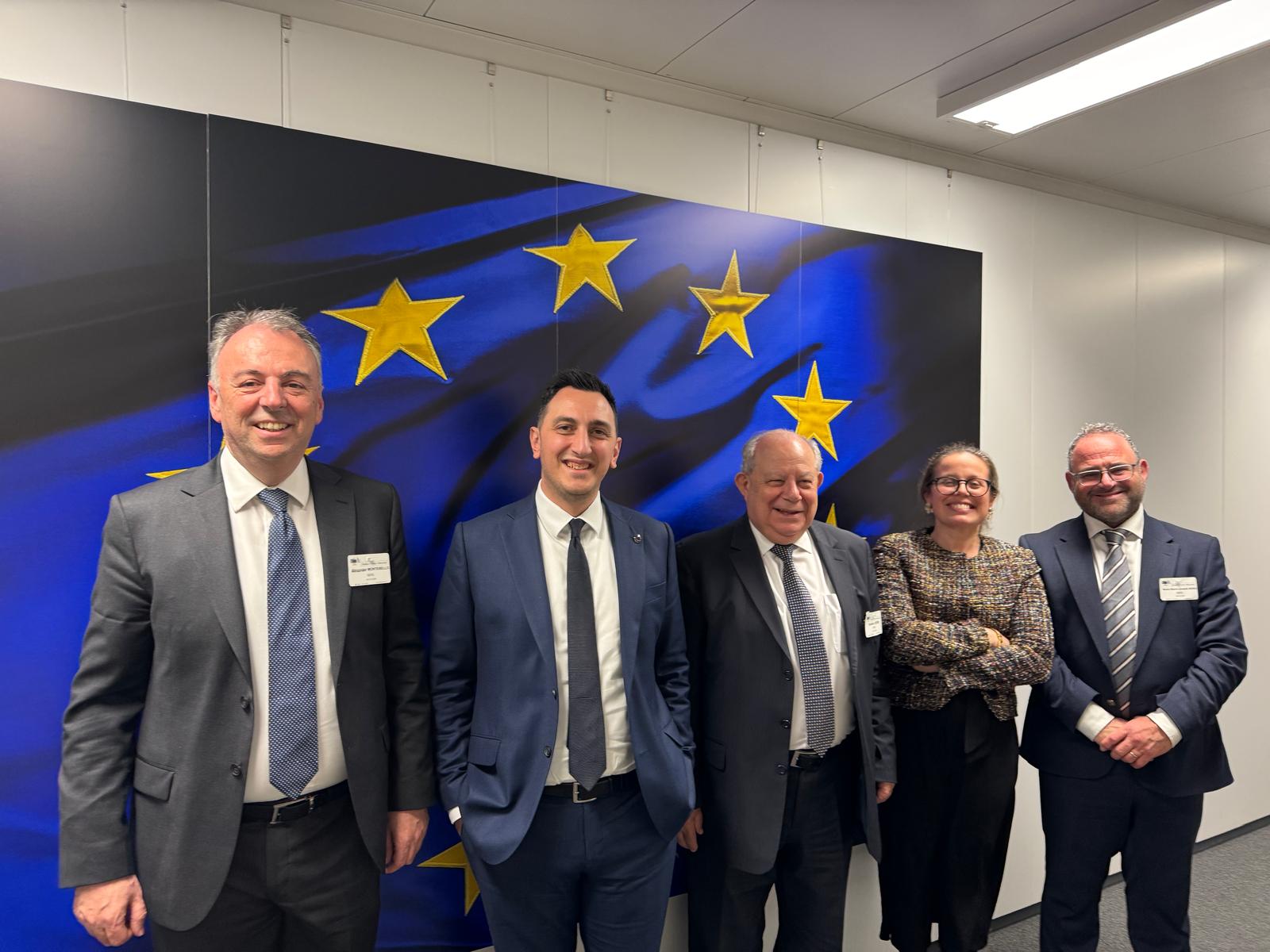
A delegation of the Malta Maritime Forum (MMF) travelled to Brussels to discuss the EU’s Emission Trading System with the EU Institutions, Industry Associations and Maltese policy interlocutors. The visit was intended to influence the forthcoming review of the Directive expected in July and served to :
- present data on the negative repercussions of ETS in terms of business and carbon leakage and
- to discuss possible alternatives to the implementation of ETS, the principles of which the Forum regards commendable.
To this end, meetings were held with the:
- European Commissioner Glenn Micallef and Head of Cabinet
- European Commission DG Clima EU ETS Head of Unit and Staff
- Deputy Permanent Representative to the EU and Maritime Attache
- European Tug Owners Association
- European Maritime Pilots Association
- European Sea Ports Organisation
- Federation of European Private Port Companies and Terminals
- European Parliament President Main Policy Advisor
- Malta’s MEPs Peter Agius, Alex Agius Saliba, Thomas Bajada, Daniel Attard and representatives from the offices of David Casa and EP President Roberta Metsola.
Whilst in Brussels the Forum sounding the alarm over the failings of EU ETS, arguing that it is failing spectacularly to achieve its commendable climate change green objectives because it is unable to enforce its Directive outside its jurisdiction. As a result, transhipment business is largely shifting to new and expanded transhipment hubs that have mushroomed along the coast of North Africa to capture the business of cargo carriers that are re-routing away from EU ports to avoid ETS requirements with the risk of reducing southern EU ports to feeder hubs playing a secondary role to extra-EU ports where global cargo will become principally transhipped.
This effect runs diametrically counter to the objectives of the Commission’s new Port Strategy which was published while the MMF was holding its talks in Brussels and producing concrete evidence that EU ports were losing rather than gaining competitiveness yet the same amount of carbon was being generated in EU waters. Hard facts were produced on the substantial growth being registered in non-EU ports at the expense of EU transhipment hubs. This shift has led to increased feeder traffic, paradoxically boosting overall emissions rather than curbing them.
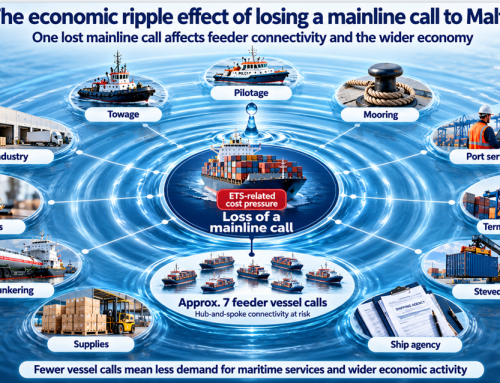
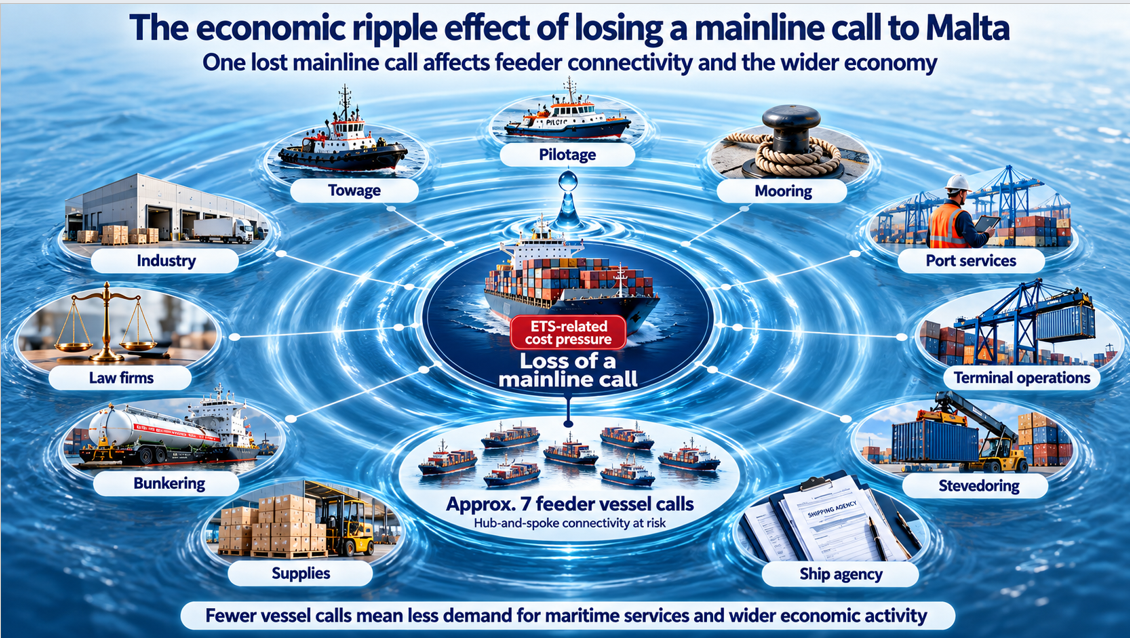
This mounting practice is creating disproportionate economic risks for small island state economies like Malta’s which rely heavily on global maritime carriers to generate jobs and export-led growth. With high ETS costs and a relatively minute domestic container volume, the island risks losing direct calls from major shipping lines. If cargo bound for Malta is unloaded at neighbouring non-EU ports, Malta’s connectivity and competitiveness are undermined, jeopardising sectors such as manufacturing and logistics.
During its active interactions in Brussels, the Forum recommended that the European Commission:
- Adopts a temporary freeze on EU ETS and FuelEU for maritime transport until the establishment of a global decarbonisation measure
- Gives clear and concrete assurances to the industry that it would withdraw its ETS and FuelEU regimes once a global system is in place
- Extends derogations for small islands to major islands and prolong the sunset clause until 2035
- Exclude EU transhipment ports—where transhipment exceeds 65% of total activity—from the definition of “port of call” under the ETS Directive.
- Exclude short sea shipping from the scope of EU ETS until road transport ETS2 is operational.
- Introduce a risk assessment mechanism for ETS monitoring, applying predictive criteria to ensure fair oversight.
The Malta Maritime Forum is most appreciative of all Maltese MEPs for their unequivocal non-partisan approach in this matter and for attending in full force for the MMF presentation. It also thanks EP President Dr Roberta Metsola and Commissioner Glenn Micallef for their support.
Buoyed by this positive feedback and support, the Forum plans to keep up its advocacy momentum with further visits in the coming weeks with a view to continue to urge EU policymakers to heed these recommendations and bring about a level playing field for all EU ports, thereby promoting an effective, sustainable and globally coordinated decarbonisation process in the maritime sector.
The MMF delegation consisted of Godwin Xerri, Chairman; Alex Montebello, Vice Chairman; Claudia Vella Casagrande, Director; and Kevin J Borg, CEO.