An Evidence-Based Case for a Single, Global Decarbonisation Regime for Shipping
Executive Summary
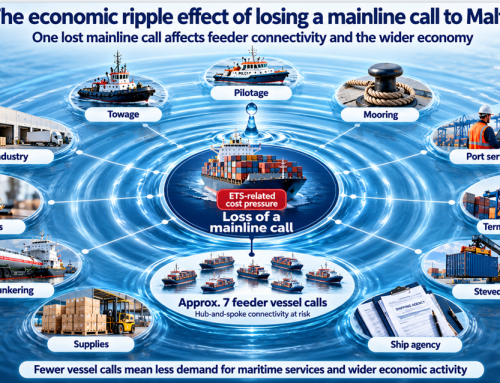
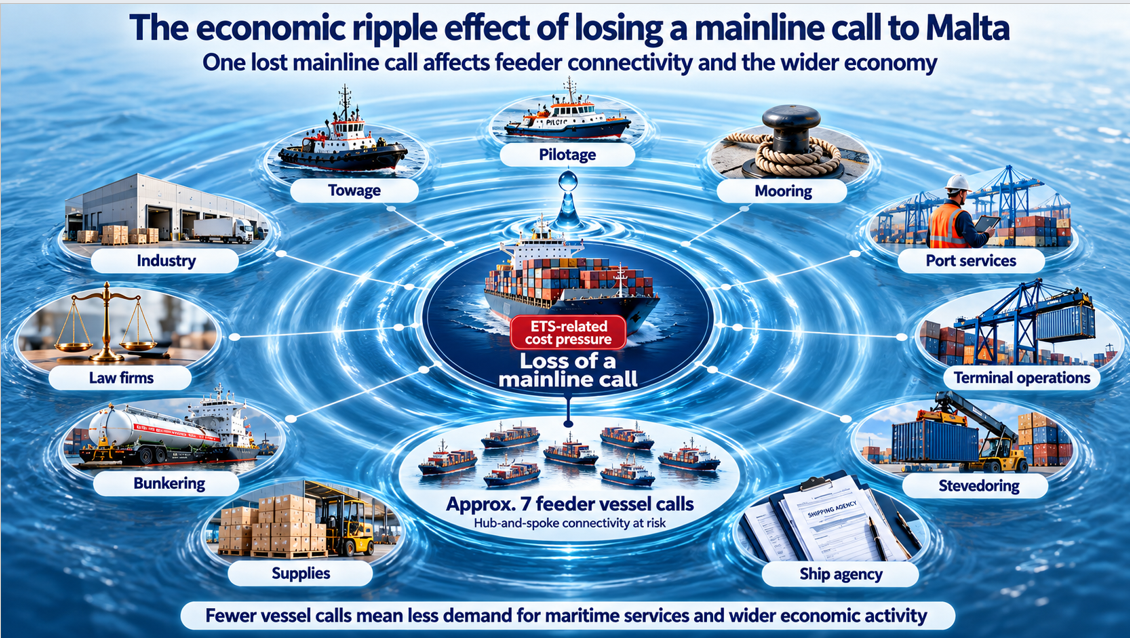
Malta, as an EU, Island Member State continues to be exposed to disproportionate risk to its international connectivity and consequent economic wellbeing under the current extension of the European Union Emissions Trading System (EU ETS) to maritime transport.
This paper presents an urgent, evidence-based call for the dismantling of the EU ETS regime and its substitution with the International Maritime Organization’s Net Zero Framework (IMO NZF). The analysis demonstrates that the EU ETS, unenforceable in competing non-EU ports proximate to Malta, has triggered unfair competition, business and carbon leakage, and market distortions that undermine the EU’s own climate and economic objectives. Only a single, globally harmonized regulatory framework can ensure fair competition, effective decarbonisation, and the preservation of Malta’s—and Europe’s—maritime competitiveness.
Introduction
The extension of the EU ETS to maritime shipping was intended to accelerate decarbonisation within the sector and catalyze global action. However, the adoption of the IMO Net Zero Framework (NZF) marks a pivotal moment for international climate governance in shipping, offering a comprehensive and globally coherent approach. As the EU and IMO authorities prepare for formal adoption of the NZF, it is imperative to reassess the regional measures that threaten the viability of EU and, in particular, Maltese maritime interests. Malta’s dependence on seamless maritime connectivity for trade, economic resilience, and supply-chain integrity makes it uniquely vulnerable to the competitive imbalances and inefficiencies generated by the current EU ETS regime.
Malta’s Maritime Connectivity: Strategic Importance and Risks
Malta is an island economy and a sovereign State. In the absence of any natural resources except its people, it relies on efficient maritime links to sustain itself and to generate economic activity. This disproportionate reliance and Openness to Trade are highlighted in the Table below.
Table 1
| Country | Trade Openness (% of GDP) | Container Port Traffic (TEUs per Capita) |
| Malta | 230% | 5.6 |
| Cyprus | 190% | 0.3 |
| Slovenia | 156% | 0.5 |
| Ireland | 253% | 0.2 |
| Portugal | 91% | 0.3 |
| Greece | 89% | 0.5 |
| Spain | 70% | 0.4 |
Source : World Bank. For Trade Openness the latest data available is 2024 (Trade % GDP) while the data for the Container Port Traffic (TEU: 20 foot equivalent units/Population), the most recent data available is from 2022.
Over the years, the Islands have managed to attract widespread global maritime connections to 110 ports worldwide provided by the world’s 5 major shipping carriers attracted to the Malta Freeport and the critical mass it generates through its high volumes of transshipment traffic. These routes translate into competitive sail-times and freight rates for Maltese importers, manufacturers and exporters whilst contributing to the robustness of European supply chains.
The global maritime connections enjoyed by Malta and its economy exist only because of the efficiencies and throughput of the Malta Freeport which typically stands at 3million TEUs per year. Of this, only 134K TEUs are destined for domestic use. Such a small proportion does not economically justify a stop-over in Malta using mega-carriers thereby placing the maritime connections Malta currently enjoys at great risk if shipping lines decide to re-route elsewhere due to EU ETS.
The continued imposition of EU ETS on maritime transport would therefore prolong and extend the disproportionate risk to Malta’s connectivity. A retention of EU ETS (over and above other similar levies) on ships calling at EU ports—including Malta— will continue to incentivise (a) the redirection of shipping routes and port calls outside of the EU and (b) further investment in transshipment capacity outside the EU. This would seriously undermine Malta’s connectivity upon which depends its economic and social wellbeing, threatening “Quality Jobs” which the EU is currently promoting through its Roadmap.
Unfair Competitive Conditions: The Non-EU Port Advantage
The competitive disadvantage imposed by the EU ETS is especially acute for Malta due to its proximity to rapidly expanding North African transshipment hubs. Ports in Egypt and Morocco, such as Abu Qir, Damietta, Alexandria, Tangier Med, and Nador West Med, are not subject to the EU ETS if ships are calling or proceeding from/to other non-EU ports. On the other hand, if ships are calling or proceeding from/to EU ports, they are liable to pay 50% of the cost. These non-EU ports and have attracted significant investment from European shipping companies seeking to avoid the added costs of the ETS. These non-EU ports offer substantial savings—estimated at €13 million to €35 million per shipping service per year—making them highly attractive alternatives for transshipment. The inability to enforce the EU ETS beyond EU jurisdiction creates a regulatory asymmetry that distorts competition, erodes the market share of EU ports and directly undermines Malta’s maritime sector.
Evidence of Business and Carbon Leakage
Empirical evidence underscores the reality of business and carbon leakage resulting from the EU ETS. Since the regime’s implementation, several major shipping lines have restructured their Mediterranean operations to favor non-EU ports:
- On January 15, 2025, Maersk shifted its MECL service from Algeciras (Spain) to Tangier Med (Morocco), marking a significant reorientation of regional logistics.
- Maersk APM and Hapag Lloyd announced a strategic collaboration (Gemini Cooperation) launching in February 2025, leveraging Tangier Med’s capacity.
- The Alliance (Hapag-Lloyd, ONE, Yang Ming) adjusted its Asia–North Europe FP1 service in December 2023 to include Damietta (Egypt).
- Evergreen has declared that, from 2026, Abu Qir (Egypt) will replace Piraeus (Greece) as its primary transshipment hub, with further service expansions planned for 2027.
These shifts are not isolated incidents; rather, they reflect a broader pattern of investment and operational realignment that disadvantages EU ports, including Malta, while failing to deliver genuine emissions reductions. The same ships, now calling at non-EU ports, continue to traverse the Mediterranean, often emitting more carbon due to increased feedering and longer routes. Despite this, the European Commission’s own reporting has not fully acknowledged the scale of these changes, though it concedes that its analysis has limitations and should be interpreted with caution.
Regulatory Overlap and Market Distortion
The coexistence of regional measures such as the EU ETS and FuelEU Maritime with the emerging global IMO NZF would create a fragmented regulatory landscape. This overlap would lead to double payments, heightened administrative complexity and regulatory uncertainty for shipping companies operating in and out of Malta or any other EU port. It also increases the risk of market distortions and business leakage, as companies restructure their operations to avoid EU-specific costs. Such outcomes threaten the competitiveness, cohesion, and socio-economic resilience of Malta and the wider EU maritime sector, directly contravening the EU’s stated principles of fair competition and de-risking.
Call for Harmonisation: The Case for the IMO Net Zero Framework
The adoption of the IMO Net Zero Framework presents a unique opportunity to achieve regulatory harmonisation and restore a level playing field in maritime decarbonisation. Malta, through the Malta Maritime Forum, strongly urges the European Commission and EU Member States to support the formal adoption of the NZF and commit to withdrawing regional measures like the EU ETS and FuelEU Maritime. A single, predictable international regime is indispensable for fair competition, effective emissions reduction, and the long-term sustainability of global shipping. Such harmonisation would also minimize the risk of double taxation, reduce administrative burdens, and prevent further business and carbon leakage.
Recommendations
- Immediate Alignment: The European Commission and EU Member States should unequivocally support and formally adopt the IMO Net Zero Framework at the forthcoming MEPC meeting, ensuring that it supersedes existing regional measures.
- Withdrawal of Regional Schemes: Upon adoption of the IMO NZF, the EU should withdraw the maritime extension of the EU ETS and FuelEU Maritime, eliminating regulatory overlap and restoring competitive parity for EU ports, including Malta.
- Safeguards for Malta: The EU should implement targeted measures to safeguard Malta’s maritime connectivity and economic resilience during the transition, including monitoring for business and carbon leakage and providing support for affected sectors.
- Ongoing Evaluation: The European Sustainable Shipping Forum (ESSF) should conduct regular assessments of the impacts of regulatory changes on EU maritime competitiveness, with particular attention to island and peripheral Member States.
- Global Engagement: The EU should intensify engagement with IMO and international partners to ensure robust enforcement and continuous improvement of the Net Zero Framework, fostering true decarbonisation without sacrificing economic vitality.
Conclusion
Malta’s unique vulnerability as an island nation at the crossroads of global trade underscores the urgent need for a coherent, fair, and effective regulatory framework for maritime decarbonisation. The current EU ETS regime, by fostering unfair competition and leakage, threatens Malta’s connectivity and economic security while failing to deliver its intended climate benefits. The impending adoption of the IMO Net Zero Framework offers a viable path forward—one that harmonizes global action, safeguards competitiveness, and upholds the EU’s climate and economic objectives.