The Malta Maritime Forum (MMF) has called on the government to give the maritime industry greater priority in the 2027 Budget, arguing investment in infrastructure, skills and policy coordination is essential to achieving the sector’s ambitions under Malta Vision 2050.
In its proposals for Budget 2027, the forum said the industry required renewed attention and resources, warning that the establishment of standards, key infrastructure investment and clear policy priorities could no longer be postponed.
The MMF stressed that as an island economy reliant on shipping for trade, energy and essential supplies, Malta’s port capacity and maritime connectivity were fundamental to its economic resilience and prosperity.
Timely investment, maintenance and policy coordination were therefore national necessities as well as priorities for the maritime industry.
The forum called for urgent action on critical port infrastructure, including the restoration and strengthening of the Marsaxlokk breakwater, the completion of Ras Ħanżir with a permanent, fixed roll-on/roll-off (Ro-Ro) berth, and the development of alternative arrangements for cargo operations.
It also insisted changes associated with the Grand Harbour Revival Project should not displace existing operations until suitable alternative facilities were available.
A central proposal is dedicated funding to implement the National Maritime Transport Strategy through a clear action plan setting out responsibilities, deadlines and measurable outcomes.
The MMF also proposed establishing a permanent interministerial structure to coordinate maritime policy across transport, finance, energy, climate, infrastructure and foreign affairs, ensuring that urgent priorities translate into action.
On decarbonisation and digitalisation, the forum called for a dedicated financing framework to support major projects.
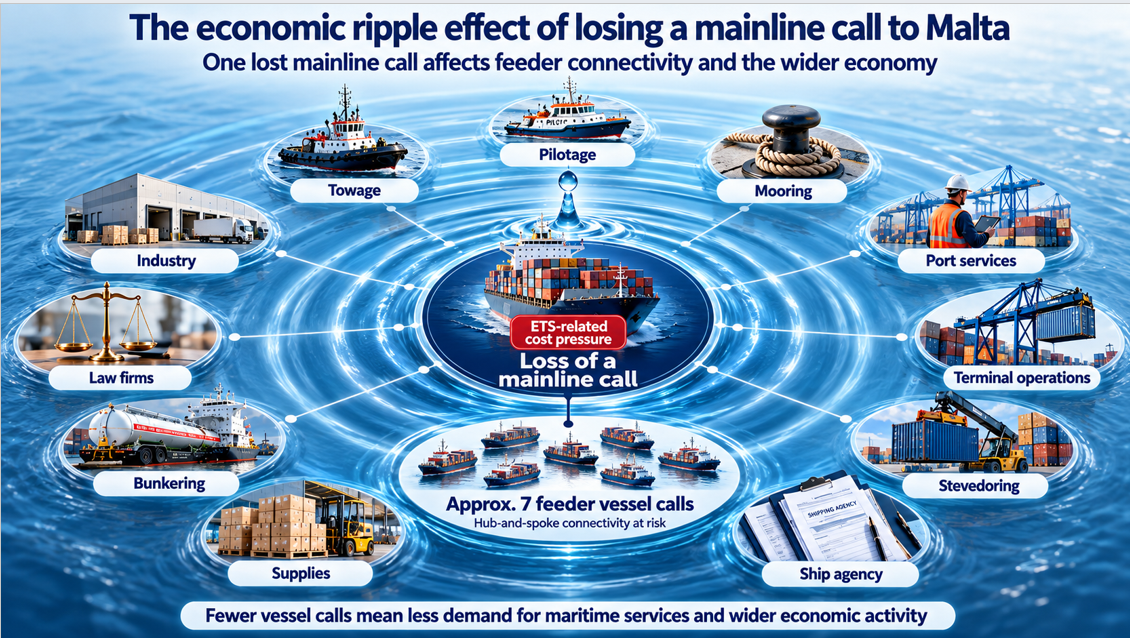
It said a meaningful share of climate-related funding generated through the EU Emissions Trading System, for as long as the system remains in place, should be reinvested in cleaner vessels, alternative-fuel infrastructure, energy-efficient port machinery and digital technologies.
Addressing skills shortages, the MMF recommended establishing a National Maritime Certification Centre, a Maritime Skills Board and a national cadetship scheme.
It also proposed a medium-term target of at least 600 valid Maltese Certificates of Competency to help develop a domestic pool of maritime professionals alongside Malta’s internationally prominent ship register.
Other proposals include shifting cargo from road to sea through a Ro-Ro link between Malta Freeport and Gozo, developing legal frameworks for cleaner marine fuels, and creating a public-private entity to promote Malta internationally as a maritime centre.
Godwin Xerri, chairman of the Malta Maritime Forum, said the country could not aspire to become a leading maritime centre while treating port resilience, maritime skills and policy coordination as secondary priorities.
“The 2027 Budget should move beyond statements of intent and provide clear responsibilities, realistic deadlines and the resources needed for implementation,” he said.
Xerri added that the proposals extended beyond support for maritime operators, encompassing Malta’s supply chains, energy security, environmental transition and ability to remain connected to international markets.
“Investment in maritime capability is investment in national resilience,” he said.
The MMF presented its proposals in separate meetings with the Minister for Sustainable Mobility, the leader of the Opposition and selected shadow ministers.
It also offered its support and expertise to the government, the Opposition and other stakeholders to help implement the proposals.
Source: MaltaToday