For many people, wars in the Middle East, Eastern Europe or the Red Sea may seem like distant events unfolding far beyond our shores. Yet for Malta, an island nation whose prosperity depends almost entirely on the uninterrupted movement of ships, conflicts at sea quickly become local concerns.
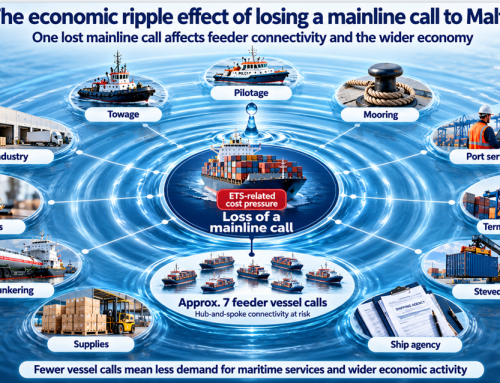
Almost everything that reaches Malta − fuel, food, medicines, raw materials and consumer goods − arrives by sea. Equally, much of the country’s economic activity is linked to the maritime sector: since Malta has no raw materials, it needs to import all its inputs and export a vast proportion of its manufactured products.
Today, the global shipping industry is facing one of its most challenging periods in decades. Armed conflicts stretching from Ukraine to the Middle East, alongside persistent security threats in parts of Africa, have transformed some of the world’s busiest sea routes into dangerous waters. Merchant vessels, once regarded as neutral carriers of global trade, increasingly find themselves caught in the crossfire.
For the thousands of men and women who crew these ships, the risks have become very real. Missile and drone attacks, piracy, vessel seizures and the constant threat of escalation have turned routine voyages into dangerous missions. Beyond the physical danger, many seafarers face growing psychological pressure as they sail through areas where commercial shipping has become an unintended casualty of geopolitical disputes.
While sea-faring careers are becoming less popular by the day, the consequences extend well beyond those on board.
Several of the world’s most important maritime chokepoints have become increasingly unstable. The Strait of Hormuz remains vital for global energy supplies, while the Black Sea continues to be affected by the war in Ukraine. Elsewhere, attacks on commercial shipping in the Red Sea have forced many vessels to take much longer routes around the Cape of Good Hope, adding weeks to voyages and significantly increasing operating costs.
These disruptions eventually find their way into household budgets.
Higher insurance premiums, longer sailing distances, increased fuel consumption and operational uncertainty all translate into higher transport costs.
For a country like Malta, which, by necessity rather than choice, must import almost all of what it consumes, these additional costs cannot simply be avoided. While Malta has little influence over global commodity prices or international shipping routes, it must absorb the consequences of decisions and conflicts taking place thousands of kilometres away.
The effects are felt across the economy. Businesses pay more for imported materials, retailers face higher distribution costs, and consumers ultimately encounter increased prices for everyday goods. All this also renders tourism, one of Malta’s main economic pillar less price competitive. Energy markets are equally vulnerable. Even when physical supplies remain available, uncertainty alone can trigger price volatility that affects electricity generation, transport and industrial production throughout Europe.
Malta’s position as a maritime nation also brings responsibilities alongside its vulnerabilities. The country’s shipping register represents thousands of vessels trading across every ocean, while the maritime services sector supports a wide network of legal, financial, technical and operational activities. Any prolonged disruption to global shipping, therefore, has implications not only for merchandise trade but also for one of Malta’s most internationally connected industries.
The human dimension should not be overlooked. Behind every cargo ship are professional seafarers who continue to keep global trade moving despite increasingly hazardous conditions. They transport the fuel that powers economies, the grain that feeds populations, the medicine that cures the sick and the products that stock supermarket shelves. Yet their work often receives little public attention until tragedy strikes.
The growing insecurity at sea also serves as a reminder that maritime security is no longer solely a concern for naval forces or shipping companies. It has become an economic issue, a supply chain issue and, ultimately, a matter of national resilience for island states such as Malta.
The reality is that Malta cannot determine the course of international conflicts, nor can it influence global shipping markets or energy prices. Those are external realities that must largely be accepted. What Malta can do is continue strengthening the resilience of its maritime sector, invest in efficient port infrastructure, support international cooperation on maritime security and maintain the competitiveness of the services that have made it one of Europe’s leading maritime jurisdictions.
The sea has always been Malta’s greatest connection to the world. It remains our principal gateway for trade, prosperity and economic opportunity. At a time when global shipping is increasingly under siege, safeguarding the resilience of maritime commerce is firmly in Malta’s national interest.
Godwin Xerri and Kevin J. Borg are the Chairperson and CEO of the Malta Maritime Forum, respectively
Source: Times of Malta/Photo: Shutterstock.com